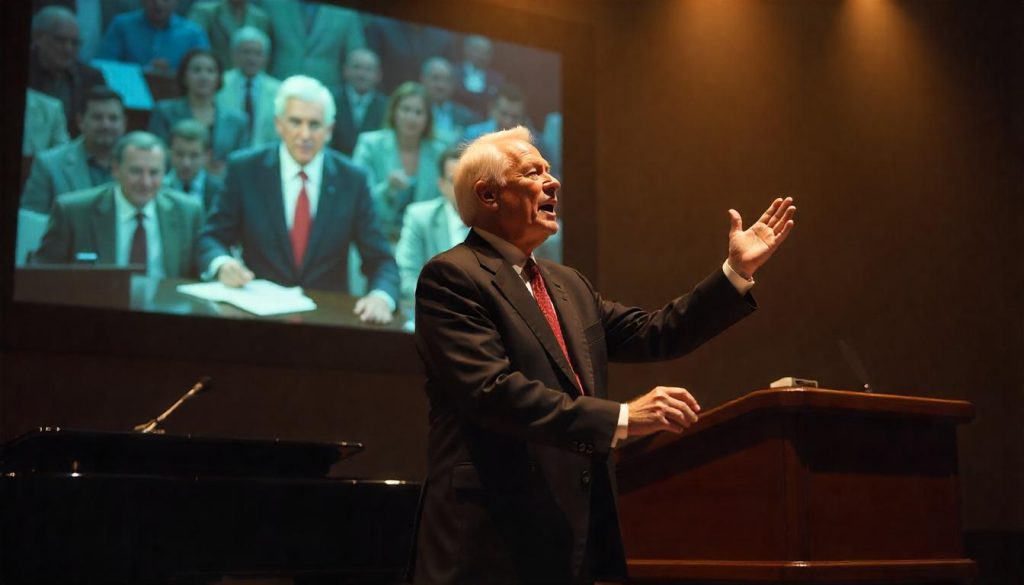

Once hailed as a voice of God and the king of televangelism, Jimmy Swaggart inspired millions with his passionate sermons and soulful gospel music. From humble beginnings in Louisiana, he climbed to global fame, drawing in packed crowds and raking in millions through his fiery preaching. But behind the pulpit, a storm was brewing — one that would eventually bring his empire crashing down.
Swaggart’s story is one of divine calling, public worship, and a shocking downfall that shook the Christian world. In this blog, we uncover the untold truths behind his rise to spiritual stardom and the scandals that led to his fall from grace. It’s a tale of glory, guilt, and the complicated intersection of faith and fame.
Jimmy Swaggart’s Childhood and the Beginning of His Musical Journey
Born on March 15, 1935, in Ferriday, Louisiana, Jimmy Swaggart grew up in a deeply religious, working-class family. His father, a sharecropper and Pentecostal preacher, instilled in him strong Christian values from an early age. But beyond faith, there was something else that captured young Jimmy’s heart — music.
From the age of 9, Jimmy started playing the piano by ear, often mimicking the styles of Southern gospel legends. He didn’t have formal training, yet his natural ability to move people with melody was unmistakable. The Swaggart household wasn’t wealthy — in fact, Jimmy often wore hand-me-down clothes and lived in poverty — but they were rich in spiritual life and musical influence. His cousins, Jerry Lee Lewis and Mickey Gilley, would also go on to become famous musicians, showing that talent clearly ran in the family.
In small country churches, Jimmy would perform gospel songs during services, sometimes drawing more attention than the sermons themselves. His deep, emotional voice and piano-playing began to win hearts across the local community. It was during these early years that he realized his calling: to preach the gospel — not just with words, but with music.
By the late 1950s, Jimmy began traveling across the southern United States as a full-time evangelist. With his Bible in one hand and his piano on the stage, he blended passionate preaching with soul-stirring performances. It was the start of a journey that would eventually make him a household name across America and beyond.
Unbelievable Popularity in Christian Television Broadcasting
By the 1970s, Jimmy Swaggart was no longer just a gospel preacher — he was becoming a national phenomenon. While many evangelists relied solely on in-person sermons or church visits, Swaggart saw the power of television as a way to spread the gospel. And he wasn’t wrong. His decision to step into the world of Christian broadcasting would soon turn him into a global name.
In 1971, Swaggart launched the Jimmy Swaggart Telecast, a half-hour television program featuring fiery sermons, passionate gospel music, and testimonies of faith. What set him apart wasn’t just his message, but how he delivered it — raw, emotional, and completely unfiltered. His voice trembled with conviction. His piano rang with heavenly rhythm. Viewers across America, many of whom never stepped inside a church, suddenly found themselves glued to his Sunday broadcasts.
By the early 1980s, his program was being aired on over 3,000 stations and cable systems worldwide, translated into dozens of languages, and reaching over 500 million people. That kind of reach was unheard of for a preacher. Swaggart became a pioneer of televangelism, joining the ranks of media giants like Billy Graham and Pat Robertson — but with a style all his own.
The funds began pouring in. His ministry, Jimmy Swaggart Ministries (JSM), grew into a multimillion-dollar empire, complete with Bible colleges, printing presses, and global outreach programs. Viewers mailed in donations in the millions, believing they were supporting God’s chosen messenger.
Swaggart’s face was on magazines. His name was on billboards. He was a preacher, a performer, and to many — a prophet. But with rising fame came rising expectations — and eventually, the cracks began to show.
The Scandal and Its Impact: The Beginning of Lost Faith
Just when Jimmy Swaggart was at the height of his fame, a devastating scandal sent shockwaves through the Christian world. In 1988, the once-revered televangelist was exposed in a sex scandal involving a prostitute — a revelation that shattered his carefully built image of purity and righteousness.
The news broke like wildfire. Tabloids, TV shows, and newspapers couldn’t get enough of the story. For a man who had publicly condemned immorality and preached strict holiness, the hypocrisy was too great for many to forgive. Millions of devoted followers who once saw him as a spiritual father now felt betrayed, confused, and heartbroken.
Swaggart tearfully confessed in front of his congregation with the now-famous words:
“I have sinned against You, my Lord…”
But for many, it wasn’t enough.
The fallout was brutal. Major Christian networks dropped his show. Donations plummeted. Fellow evangelists, including some close allies, distanced themselves. Even the Assemblies of God — the denomination under which he operated — defrocked him, stripping him of his ministerial credentials. Though he tried to continue preaching, his reputation never fully recovered.
This wasn’t just a scandal; it was a crisis of faith for countless believers. Many began to question the integrity of televangelism as a whole. If someone like Swaggart could fall so hard, who could be trusted? The scandal didn’t just damage a man — it rattled an entire generation’s trust in spiritual leadership.
For Swaggart, the road ahead would be lonely and uncertain. The empire he built with passion and charisma now stood cracked, haunted by a single, painful truth: the higher the pedestal, the greater the fall.
Attempts at Redemption After the Fall
After the scandal rocked his ministry and reputation, many believed Jimmy Swaggart’s career was finished for good. But if there’s one thing Swaggart had never lacked, it was determination. In the face of humiliation, rejection, and public ridicule, he began what many saw as a bold — if controversial — journey toward redemption.
Despite being defrocked by the Assemblies of God, Swaggart refused to walk away from the pulpit. He continued preaching at Family Worship Center, his church in Baton Rouge, Louisiana, even as his audience dwindled and media criticism intensified. His televised sermons never stopped entirely — he simply scaled them back, relying more on loyal supporters than mass media reach.
In the early 1990s, Swaggart made several emotional appeals to his followers. He admitted his faults, begged for forgiveness, and claimed he was seeking spiritual healing. But a second scandal in 1991, also involving a prostitute, made things worse. For many, it confirmed their doubts that Swaggart had truly repented. The attempt at redemption became even more fragile.
Yet remarkably, a small but devoted base of believers continued to support him. They saw not a fallen man, but a flawed soul in need of grace — someone who still preached with passion, conviction, and biblical knowledge. Swaggart leaned heavily into this support system, rebuilding his ministry slowly and away from the media spotlight.
He also focused on what had always connected him most deeply with people: gospel music. Swaggart returned to recording albums, playing the piano, and producing faith-based programs for a niche Christian audience. He began building SonLife Broadcasting Network (SBN), which today still airs his sermons and music globally.
Though his reputation never returned to its original glory, Swaggart carved out a quieter space in the religious world — not as a perfect preacher, but as a survivor of scandal who chose to keep preaching despite the fall.
A Dual Legacy: Reverence and Criticism Side by Side
Jimmy Swaggart’s story doesn’t end with fame or scandal alone — it continues through a complex legacy that still divides opinion to this day. For some, he remains a fallen hero who once preached with unmatched passion. For others, he’s the symbol of hypocrisy within modern Christianity — a cautionary tale of what happens when pride overshadows purpose.
Even after decades, Swaggart’s impact on American evangelical culture is undeniable. He helped pioneer televangelism, brought gospel music into millions of homes, and inspired countless lives through his early ministry. His musical legacy continues to resonate through the SonLife Broadcasting Network, and his family — including his son Donnie and grandson Gabriel — still carry the torch of his ministry.
But at the same time, criticism has never left his side. Many still question the sincerity of his repentance, the continued wealth of his ministry, and the ethics of his return to broadcasting after public moral failures. Skeptics argue that Swaggart’s story reflects deeper issues within religious media empires — where charisma often outweighs accountability.
What makes Swaggart’s legacy so complicated is that both views can be true. He was a gifted preacher, a brilliant musician, and a man who connected deeply with people through faith and music. But he was also deeply flawed, and his failures caused real damage — not just to his image, but to the spiritual trust of millions.
In the end, Jimmy Swaggart stands as a dual symbol:
- A reminder of the power of faith, and
- A warning of what happens when that faith becomes entangled with fame.
His legacy is still being written, not just through broadcasts and music, but in the conversations people continue to have about grace, redemption, and the human cost of spiritual failure.

